Most people track mood on its own, which is why it rarely tells them anything useful. A number from 1 to 10 scribbled in isolation doesn’t explain why yesterday felt heavy and today feels lighter. Mood doesn’t move by itself — it’s pulled around by how you slept, what you ate, and how much energy you had, often with a day or two of lag before you notice the connection.
Table of Contents
This guide walks through how to build a single daily log that tracks all four factors together, so patterns actually surface instead of staying buried across four different apps or notebooks. You’ll get a simple layout you can start using today, plus the habits that make the data worth looking back on.

Download the Free Mood, Sleep, Food & Energy Log
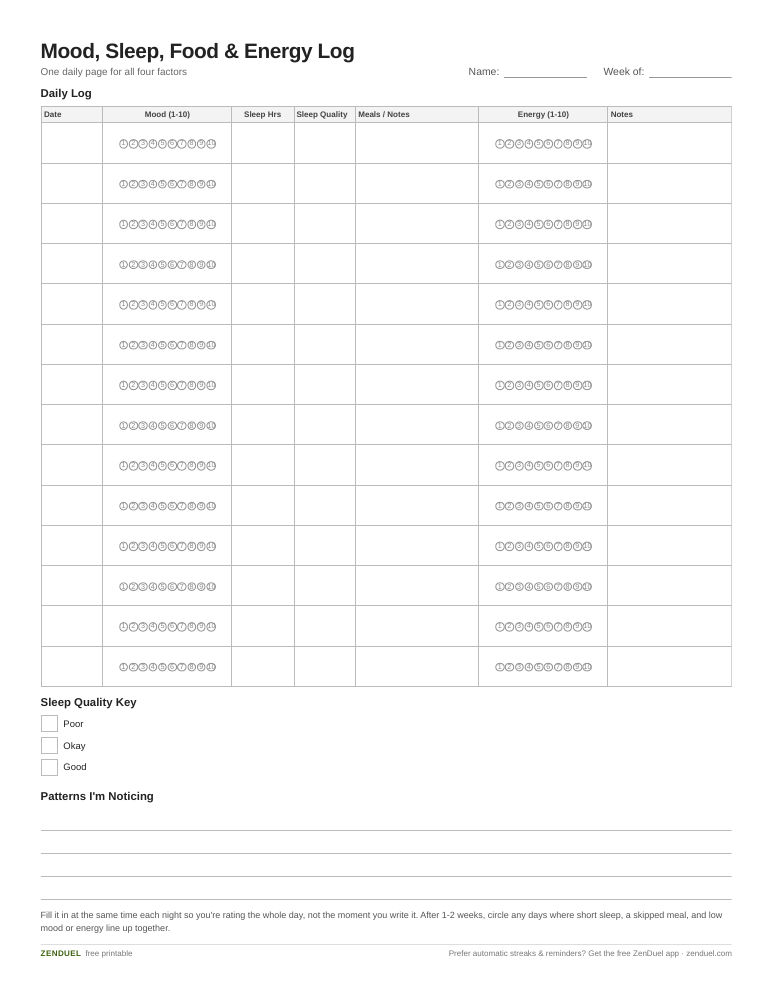
Our own printable — free, no sign-up, no email required. A two-week daily table with mood, sleep, food, and energy columns, plus space to flag recurring patterns. US Letter (prints fine on A4).
Quick Answer
Use one daily page with four quick entries — a mood rating, a sleep summary, a food snapshot, and an energy rating — logged at the same time each day. After 1-2 weeks, review the entries side by side to spot which factors tend to move together, like short sleep showing up as a low-energy, low-mood day a day or two later.
What to Put on Each Daily Log Page
Keep each entry fast enough that you’ll actually fill it in. A good daily row or block includes: the date; a mood rating on a simple 1-5 or 1-10 scale, with an optional word or emoji for nuance (‘tired,’ ‘calm,’ ‘irritable’); a sleep summary covering roughly how many hours you slept and a rough quality rating (poor/okay/good); a food snapshot — not a full diet log, just rough meal timing and anything notable like skipping a meal, heavy caffeine, or alcohol; and an energy rating for how you felt physically, split into morning and afternoon if you want more detail, since energy often dips well before mood does.
Leave a small notes space on each entry for context that a number can’t capture — a stressful meeting, a skipped workout, a big fight, a new medication. These notes are usually what explain the outliers when you look back, so don’t skip them even on days that feel unremarkable.
A layout that works well on paper or in a spreadsheet: one row per day, with columns for Date, Mood (1-10), Sleep Hours, Sleep Quality, Meals/Notes, Energy (1-10), and a wider Notes column for context. If you prefer a weekly grid instead of rows, use seven columns (one per day) and the same set of rows for each factor stacked vertically — that layout makes it easier to eyeball a full week at a glance before you even start looking for patterns.
How to Spot the Patterns Once You Have Data
Give yourself at least 1-2 weeks before drawing conclusions — a single bad day tells you nothing, but a repeated pattern across multiple weeks is worth paying attention to. Start by scanning for sleep-mood pairs first, since that link is the most consistently documented: look specifically at what your mood and energy looked like the day *after* a short or poor-quality sleep night, not just the same day, since the effect often shows up with a delay.
Next, look at food timing rather than specific foods — skipped meals, very late meals, or heavy caffeine/alcohol days tend to correlate with energy dips or mood swings more reliably than any single ingredient. Circle or highlight days where two or more factors line up (e.g., short sleep + skipped lunch + low mood) so the recurring combinations stand out visually instead of getting lost in a wall of numbers.
Once you’ve spotted a pattern, test it on purpose: if short sleep keeps tracking with low mood two days later, try protecting your sleep for a week and watch whether mood and energy shift. That turns the log from a passive record into something that actually changes how you feel.

Tips / Common Mistakes
Log at a consistent time, ideally the same time each evening, so you’re rating the whole day rather than just how you feel in the moment you happen to write it down. Keep every entry short — if filling in the log takes more than a minute or two, you’ll stop doing it within a week.
Don’t wait for a ‘bad enough’ day to start; the log is only useful with a baseline of ordinary days to compare against. Avoid chasing a specific number or streak — the goal is noticing patterns, not hitting a score. And resist the urge to over-explain every entry; a few words in the notes column beats a paragraph, since you’re building a dataset you’ll actually reread.
If you’re also managing a diagnosed mood condition, this kind of log is a good complement to professional care, not a substitute for it — bring a few weeks of entries to a therapist or doctor rather than trying to self-diagnose from the patterns alone.
Explore more: more mental health tracking guides.
Mood, Sleep, Food, and Energy Log FAQs
Should I use a 1-10 scale or emojis for mood?
Either works — a number is faster to log and easier to scan for trends over time, while an emoji or short word adds nuance a single digit can’t capture. Many people use both: a quick number plus one word.
How long before I see useful patterns?
Give it at least 1-2 weeks of consistent logging, and ideally 3-4 weeks if you want to catch patterns tied to your weekly schedule, like weekends versus workdays.
Do I need to track everything I eat?
No — a full food diary adds friction and most people abandon it within days. Track meal timing and anything notable (skipped meals, heavy caffeine or alcohol, a very different-than-usual day) instead of counting every item.
What if my mood and sleep don’t seem connected at all?
That’s useful information too. Not everyone’s mood tracks sleep closely — for some people, stress, social interaction, or physical activity turns out to be the bigger driver. The point of logging all four factors together is letting the data show you which one actually matters for you.
Skip the Spreadsheet — Track It in ZenDuel
Habit streaks, mood tracking, and accountability duels in one free app — no template maintenance required. Get ZenDuel.
Want a calmer inbox? Subscribe to the free newsletter.
Photo by Sixteen Miles Out on Unsplash.