Perimenopause and menopause don’t show up as one tidy symptom — they show up as a mood that tanks for no reason, a night of sweat-soaked sheets, a word you suddenly can’t find, and a period that’s two weeks early or three weeks late. Taken one at a time, none of it seems worth mentioning at your next checkup. Written down over a few months, the pattern becomes obvious, and that pattern is exactly what helps a doctor tell perimenopause apart from thyroid issues, depression, or something else entirely.
Table of Contents
This guide walks through exactly what to log each day, how to lay it out so it’s actually quick to fill in, and the mistakes that make trackers get abandoned by week two. You’ll find a free, ready-to-use tracker to download below — print it or fill it in digitally, no sign-up required.

Download the Free Perimenopause & Menopause Mood Tracker
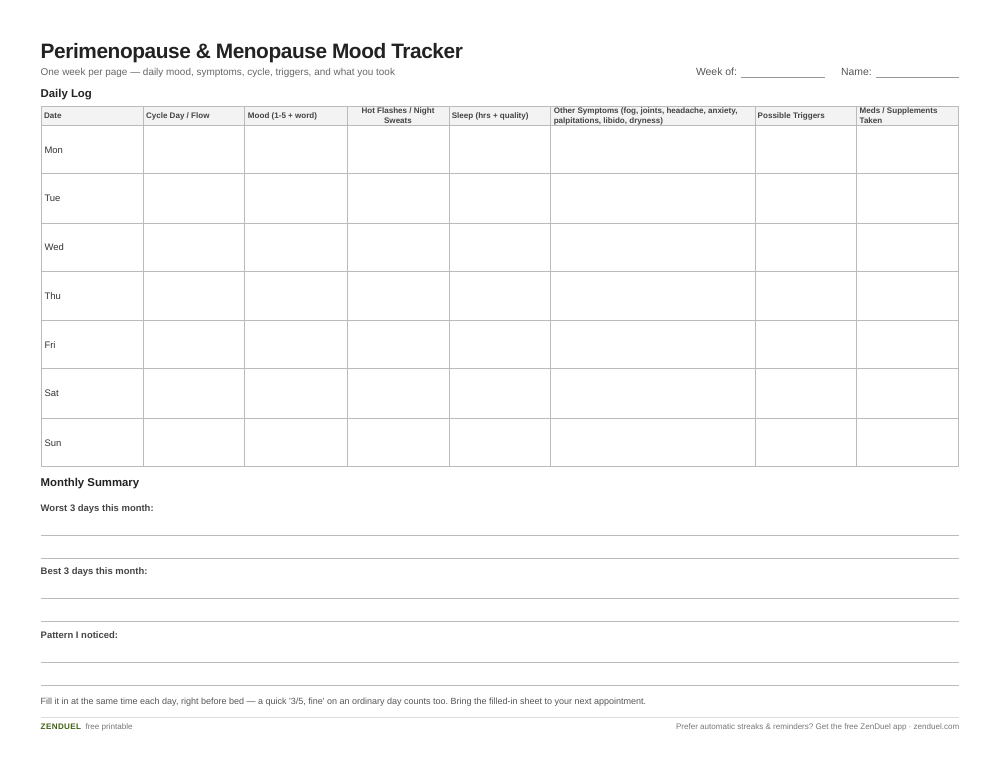
Our own printable — free, no sign-up, no email required. A one-week daily grid (mood, symptoms, cycle, triggers, meds) plus a monthly summary section for worst/best days and patterns. US Letter (prints fine on A4).
Quick Answer
A useful perimenopause/menopause tracker logs five things daily: your mood (and intensity), physical symptoms (hot flashes, sleep, brain fog, joint pain, etc.), menstrual cycle status, possible triggers (stress, caffeine, alcohol, poor sleep), and anything you took (medication, HRT, supplements). A few lines a day for 2-3 months gives you and your doctor a real pattern instead of a vague ‘I’ve been off lately.’
What to Log Each Day
Mood: Don’t just write ‘bad day.’ Note the dominant feeling — irritable, anxious, flat, weepy, foggy-headed, or genuinely good — and rate its intensity on a simple 1-5 scale. Over time this is what reveals whether your low moods cluster around certain days of your cycle or show up randomly.
Physical symptoms: Hot flashes and night sweats (how many, how disruptive), sleep (hours and quality, not just whether you slept), brain fog or word-finding trouble, joint or muscle aches, headaches, heart palpitations, vaginal dryness, and changes in libido. You don’t need all of these every day — just check off what actually happened.
Cycle status: If you’re still getting periods, note the date, flow (light/moderate/heavy), and anything unusual (skipped, early, spotting). Irregular cycles are often the first sign of perimenopause, and tracking them alongside mood is what shows whether your symptoms move with your hormones.
Possible triggers: Alcohol, caffeine, poor sleep the night before, a stressful event, or a skipped meal can all intensify hot flashes and mood swings. A one-line note (‘wine + bad sleep’) is enough to start spotting your own patterns.
Medications and supplements: Anything you took that day — HRT, birth control, magnesium, black cohosh, antidepressants, sleep aids — so you and your doctor can see what’s actually helping versus what isn’t moving the needle.
How to Lay Out Your Tracker
The free download gives you a one-page-per-week layout with a row for each day and columns for: Date, Cycle Day/Flow, Mood (1-5 + one-word description), Hot Flashes/Night Sweats (tally), Sleep (hours + quality rating), Other Symptoms (checkboxes for brain fog, joint pain, headache, anxiety, palpitations, low libido, vaginal dryness), Possible Triggers (short note), and Medications/Supplements Taken.
Below the weekly grid there’s a short monthly summary section — space to jot your worst 3 days, your best 3 days, and any pattern you noticed — so you walk into an appointment with a one-paragraph summary instead of a stack of raw data. Fill it in on paper, print extra weeks as you go, or copy the grid into a notes app if you’d rather track digitally.

Tips and Common Mistakes
Keep it to 60 seconds a day. The trackers people actually stick with are the ones with checkboxes and short scales, not ones that demand a paragraph every night. Log at the same time each day — right before bed works well, since you’re summarizing the whole day at once.
Don’t skip the ‘good’ days. A tracker that only fills in on bad days makes every pattern look worse than it is. Logging even a quick ‘3/5, fine’ on an ordinary day gives you the baseline that makes the rough days stand out.
Bring it with you to appointments. A filled-in tracker is far more useful to a doctor than trying to recall ‘some weeks I feel awful’ from memory — it’s the difference between a guess and a pattern they can actually act on.
Don’t wait for a ‘bad enough’ month to start. Perimenopause can stretch over several years, and symptoms often shift as it progresses. Starting your log now — even if things feel manageable — gives you a clean baseline to compare against later.
Explore more: More mental health tools and guides.
Perimenopause and menopause mood tracker FAQs
How long should I track before seeing a doctor?
Two to three months of daily logging is usually enough to show a clear pattern in mood, cycle changes, and physical symptoms — enough for a useful conversation with your doctor, though you can bring in a tracker at any point if symptoms feel urgent or severe.
Is mood swings in perimenopause normal, or could it be depression?
Hormonal mood swings in perimenopause are common and tend to come and go, often tracking with cycle changes or poor sleep. Persistent low mood, loss of interest in things you normally enjoy, or thoughts of self-harm are different and warrant talking to a doctor regardless of what your tracker shows — don’t wait on the log to bring it up.
Do I need an app, or is paper fine?
Either works — what matters is that you actually fill it in consistently. Paper is easier to glance at and bring to appointments; an app can be easier to carry around and search later. Pick whichever one you’ll realistically keep up for a few months.
Skip the Spreadsheet — Track It in ZenDuel
Habit streaks, mood tracking, and accountability duels in one free app — no template maintenance required. Get ZenDuel.
Want a calmer inbox? Subscribe to the free newsletter.
Photo by Marcos Paulo Prado on Unsplash.