If you or someone you love lives with bipolar disorder, a daily mood chart is one of the simplest tools for turning a foggy sense of “things have been rough lately” into something concrete you can actually act on. Instead of trying to remember three weeks back at your next appointment, you have a record showing exactly when your mood shifted, how your sleep changed first, and what was going on around it.
Table of Contents
This guide walks through how to use a mood chart for bipolar disorder day to day, what to track and why it matters, and common mistakes that make people give up on tracking too soon. You’ll also find a free downloadable mood chart template attached to this post, ready to print or fill in digitally — no sign-up required.
Download the Free Bipolar Mood Chart
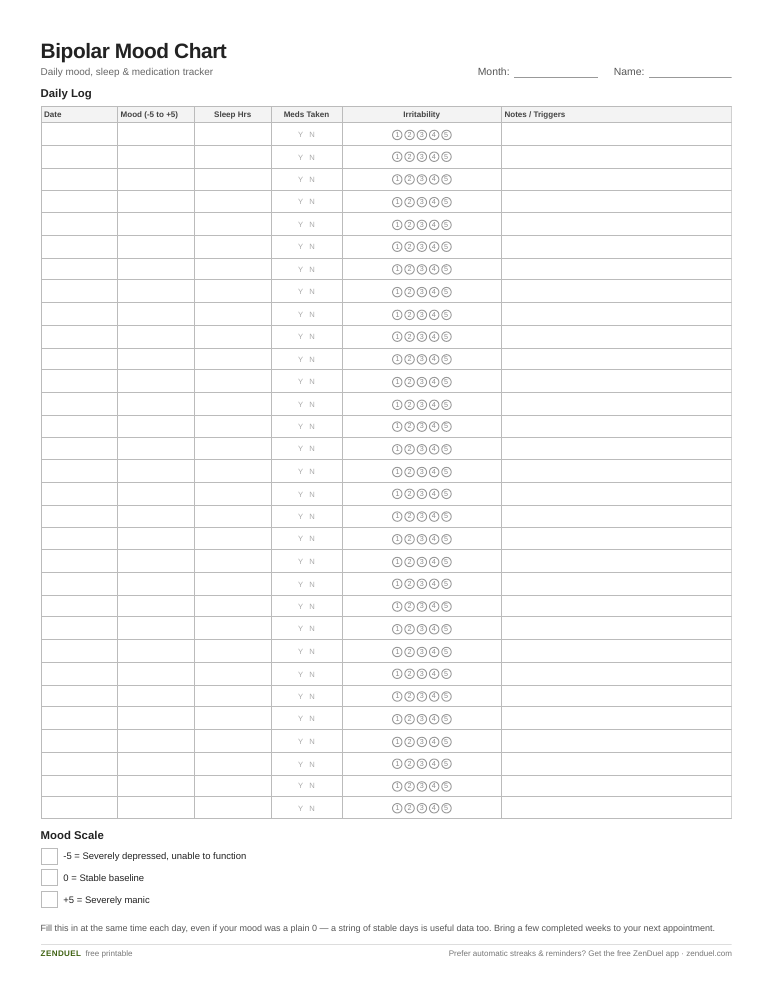
Our own printable — free, no sign-up, no email required. A 31-day table logging mood (-5 to +5), sleep hours, medication, irritability, and notes/triggers, with a mood scale key. US Letter (prints fine on A4).
Quick Answer
A bipolar mood chart is a daily log where you rate your mood on a simple scale (from depressed to manic), plus track sleep hours, medication, and any major life events or triggers. Fill it in at roughly the same time each day, and review it weekly or before appointments to spot patterns — especially early warning signs that a mood episode is starting, since sleep changes and irritability often show up before mood does.
What to Track on Your Mood Chart
The free chart attached to this post is laid out as a simple grid: one row per day down the left side (enough rows for a full month), and columns across the top for Date, Mood Rating, Sleep Hours, Medication Taken (yes/no), Irritability, and Notes/Triggers. The Mood Rating column uses a -5 to +5 scale, with 0 as your stable baseline, negative numbers running down into depression (-5 being severely depressed, unable to function), and positive numbers running up into hypomania and mania (+5 being severely manic). This mirrors the approach used in clinical tools like the NIMH Life Chart Method, which rates mood severity by how much it’s affecting daily functioning rather than asking you to guess a precise number out of nowhere.
Sleep gets its own column because changes in sleep — sleeping much less and feeling fine, or sleeping far more than usual — are frequently the first sign of a shift, often showing up days before the mood change itself is obvious. Medication tracking matters too: if you start, stop, or change a dose, note it on the same day so you and your prescriber can later see how it lined up with your mood. The Notes/Triggers column is for anything unusual that day — a stressful event, alcohol, a missed dose, a change in routine, a big argument, travel, or a period change if that’s relevant for you. Over a few weeks, these notes often reveal patterns you’d never catch by memory alone.
How to Use It Day to Day
Pick one consistent time to fill it in — right before bed works well for most people, since you can rate the whole day at once and log that night’s expected sleep plan. It only takes about 30 seconds once it’s a habit. Keep the chart somewhere you’ll actually see it: on your nightstand if you’re using the printable version, or set a daily phone reminder if you’re filling it in digitally.
Don’t skip a day just because your mood felt “normal” — a string of 0s (stable baseline) is exactly the information your doctor needs to see, and gaps in the chart make patterns harder to spot later. If you miss a day, just pick back up rather than trying to fill it in from memory; an honest gap is more useful than a guessed entry.
Bring the filled-in chart (or a photo of it) to psychiatry and therapy appointments. A few weeks of data lets your provider see the actual shape of your mood cycling — how long episodes last, how often they occur, and whether a medication change coincided with a shift — instead of relying on how you happen to feel in that one session. Many people also use a phone app such as Daylio or eMoods alongside or instead of the printable chart, since some apps can generate a summary report to share with a provider; the printable chart works just as well and doesn’t require an account or subscription, so use whichever format you’ll actually stick with.
Tips / Common Mistakes
The biggest mistake is overcomplicating the chart at the start — trying to track ten variables on day one usually means the habit dies within a week. Start with just mood and sleep, then add columns like medication or triggers once the daily habit is solid. Another common mistake is only filling in the chart during a crisis and abandoning it once you feel better; the stable, “boring” days are just as important because they establish your baseline and make it obvious when something is starting to shift. Finally, rating your mood in vague terms like “okay” or “bad” instead of using the numeric scale makes the chart much harder to read at a glance weeks later — a consistent -3 to +3 scale, filled in the same way every day, is what makes the pattern visible.
Explore more: more mental health tools and guides.
Mood chart for bipolar disorder FAQs
How often should I fill out a bipolar mood chart?
Daily, at roughly the same time each day. Even a quick 30-second entry is far more useful over time than a detailed entry done only once a week, since daily tracking is what reveals early warning signs.
What scale should I use to rate my mood?
A simple numeric scale works best — the attached template uses -5 (severely depressed) to +5 (severely manic), with 0 as your stable baseline. Rating by how much your mood is affecting your ability to function, rather than trying to pin down an exact feeling, tends to be easier and more consistent day to day.
Can a mood chart replace seeing a psychiatrist or therapist?
No. A mood chart is a self-monitoring tool that makes your appointments more useful by giving your provider real data, but it doesn’t replace diagnosis, medication management, or therapy. If you notice signs of a developing episode or have thoughts of self-harm, contact your provider or a crisis line right away rather than waiting for your next appointment.
Is the mood chart template free to download?
Yes — the printable mood chart on this page is free with no sign-up required, and you can print a new copy each month or reuse a digital version.
Skip the Spreadsheet — Track It in ZenDuel
Habit streaks, mood tracking, and accountability duels in one free app — no template maintenance required. Get ZenDuel.
Want a calmer inbox? Subscribe to the free newsletter.
Photo by Prophsee Journals on Unsplash.