You’re exhausted. Your body wants sleep. But the moment your head hits the pillow, your brain launches into a full recap of everything you said wrong three years ago, tomorrow’s meeting agenda, and that one email you forgot to send. If this sounds familiar, you’re not broken — your brain is simply stuck in problem-solving mode when it should be powering down.
Table of Contents
The good news: a targeted wind-down routine can genuinely change this. Not a vague ‘relax more’ directive, but a specific sequence of actions that signals your nervous system it’s safe to disengage. This guide walks through exactly what to do, when to do it, and the science-backed tricks that work specifically for overthinkers.

Quick Answer
Start a 60-minute wind-down about an hour before bed: do a 10-minute brain dump (write every worry and task onto paper), then move through a short physical ritual like a warm shower, followed by a screen-free calming activity. If thoughts still spiral after you lie down, use cognitive shuffling — a mental technique that scrambles your brain’s problem-solving loop and nudges it toward sleep. Consistency across multiple nights matters as much as any single technique.
Your Step-by-Step Wind-Down Routine
60 minutes out — Do a brain dump. Grab a notebook and spend 10 minutes writing down every unfinished thought, tomorrow’s tasks, and any worries circling your head. The goal is not to solve them — it’s to offload them from active memory. Research in cognitive behavioral therapy for insomnia (CBT-I) strongly supports scheduled ‘worry time’ earlier in the evening as a way to prevent those thoughts from ambushing you at 2 a.m.
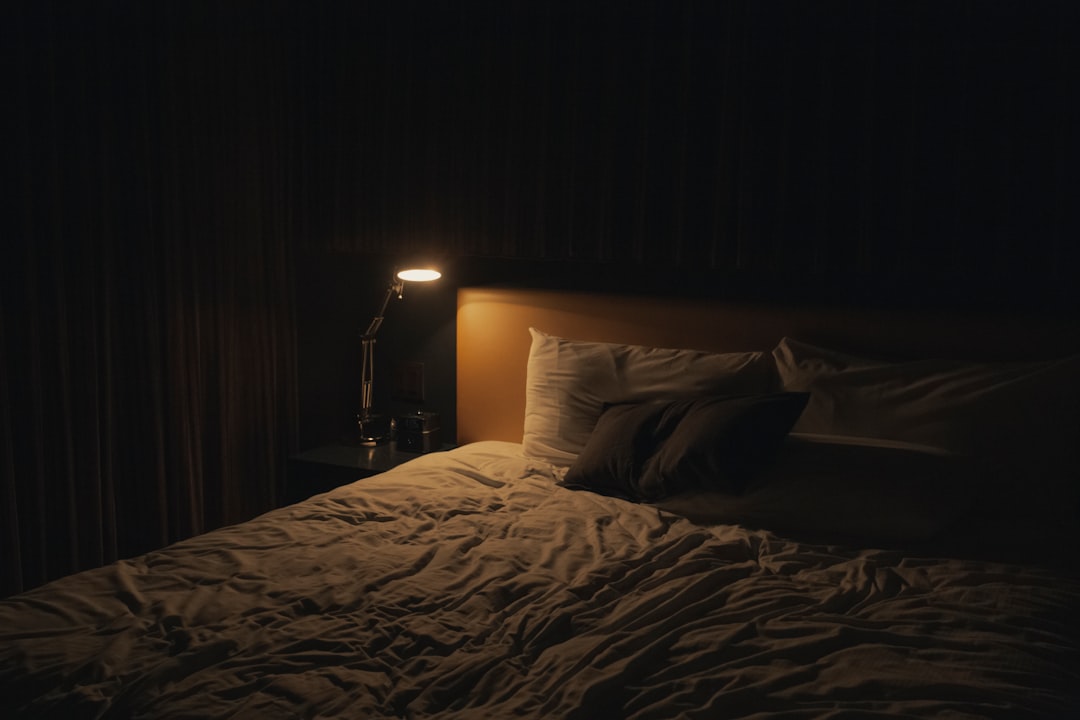
45 minutes out — Dim your environment. Lower the lights in your home, switch off overhead lighting in favor of lamps, and put devices into Do Not Disturb mode. Blue-spectrum light from screens delays your body’s natural melatonin release, so a hard stop on phones and laptops at this point gives your biology time to catch up.
30 minutes out — Take a warm shower or bath. This works via a counterintuitive mechanism: the warm water raises your surface skin temperature, and when you step out, your core body temperature drops. That drop is one of the signals your brain uses to initiate sleep. Even a 10-minute shower counts.
15 minutes out — Engage in one screen-free calming activity. Read a physical book (fiction works especially well because it pulls your attention into a different world), do gentle stretching or yoga, brew a cup of herbal tea (chamomile or passionflower are common choices), or try journaling — not processing-style writing but simple gratitude or freeform notes. The key is that the activity occupies just enough of your attention to crowd out anxious loops without stimulating you further.
At bedtime — Use a breathing anchor. Once you’re in bed, try box breathing: inhale for 4 counts, hold for 4, exhale for 4, hold for 4. Repeat several times. Slow, regulated breathing activates your parasympathetic nervous system — the body’s ‘rest and digest’ mode — and directly counters the physiological arousal that keeps overthinkers awake.
The Cognitive Shuffle: Your Secret Weapon for a Spinning Mind
If you follow all the steps above and thoughts still race the moment you lie down, cognitive shuffling is worth learning. Developed by cognitive scientist Dr. Luc Beaudoin, the technique works by feeding your brain a stream of random, emotionally neutral imagery — which disrupts the coherent narrative your mind needs to keep worrying.
Here’s how: pick any ordinary word (say, ‘candle’). Slowly visualize a random object for each letter — C for ‘cloud,’ A for ‘anchor,’ N for ‘needle,’ and so on. The images should be bizarre, unconnected, and mundane all at once. This scrambles your brain’s pattern-making machinery. According to Beaudoin’s somnolent information processing theory, the brain interprets incoherent, non-threatening imagery as a signal that it’s safe to transition into sleep. Users typically report falling asleep within a few minutes of starting the technique, though results vary and it’s most effective as part of a consistent overall routine.
Cognitive shuffling is not a cure for chronic insomnia, and it doesn’t replace professional support. But for the overthinker who simply can’t let thoughts go, it’s a practical tool that requires no apps, no equipment, and no willpower — just a willingness to think about a floating cloud followed by an anchor.
Common Mistakes That Undermine Your Wind-Down
Trying to wind down in the same room where you work. If your brain associates your bedroom — or even your couch — with emails and decisions, the environment itself becomes a cue for alertness. If you can, keep work physically separate from sleep spaces, even just by closing the laptop in a different room before starting your routine.
Using the routine only when you’re desperate. The whole mechanism depends on conditioning: your brain learns to associate the sequence of actions with sleep onset. Doing it only on bad nights is like practicing an instrument randomly and expecting to play a concert. Aim for the same sequence at roughly the same time every night, including weekends.
Going to bed before you’re actually sleepy. Lying in bed awake trains your brain to associate the bed with wakefulness — the opposite of what you want. This is a core principle of CBT-I, the gold-standard behavioral treatment for insomnia: use the bed only for sleep. If you’ve been in bed for more than 20 minutes without sleeping, CBT-I recommends getting up, doing something calm in low light, and returning only when you feel genuinely sleepy.
Skipping the brain dump because it feels too simple. Many overthinkers dismiss journaling or task-listing as too basic to matter. In practice, the brain keeps looping on open loops — things that feel unresolved. Writing them down creates a ‘holding place,’ and your mind can, at least partially, let go. It works precisely because it’s low-tech.
Explore more: More Wellness Guides.
Wind-Down Routine for Overthinkers FAQs
How long should a wind-down routine be for someone with racing thoughts?
Aim for 45 to 60 minutes. Shorter than that and your nervous system doesn’t have enough time to shift out of high-alert mode, especially if your day was stressful. You can compress the routine to 30 minutes once it becomes habitual, but when you’re first building the habit, give yourself the full hour.
Is there anything I can take to help turn off my brain at night?
Herbal options like chamomile tea or magnesium glycinate are commonly used for relaxation, though individual results vary. Melatonin can help with sleep timing but doesn’t address racing thoughts directly. For persistent cognitive arousal, behavioral approaches — particularly CBT-I — have the strongest evidence base. If anxiety or rumination is severe, speaking with a doctor or therapist is the best next step.
Why do my thoughts race specifically at night and not during the day?
During the day, external stimulation — work, conversations, tasks — gives your brain something to focus on. At night, that input disappears, and your brain’s default mode network becomes more active, surfacing unresolved concerns and anxious loops. It’s not that the thoughts are worse at night; it’s that there’s nothing else competing for attention. A wind-down routine gradually teaches your brain to redirect that activity toward rest rather than rumination.
Build Better Habits With ZenDuel
Track your habits and mood, stay accountable, and build a calmer routine — get the ZenDuel app. Get ZenDuel.
Photo by Jp Valery on Unsplash.
