The inbox is overflowing, your calendar is stacked back-to-back, and your chest feels tight — but you can’t exactly leave your desk for a 20-minute meditation retreat. The good news is you don’t need to. A few minutes of focused breathing and body awareness, done right where you’re sitting, can measurably calm your nervous system and clear your head enough to get back to work.
Table of Contents
This guide walks through several desk-friendly meditation techniques — from a 60-second breathing reset to a longer 5-minute practice — plus how to make it discreet enough for an open office and what mistakes tend to derail people who are new to it.
Quick Answer
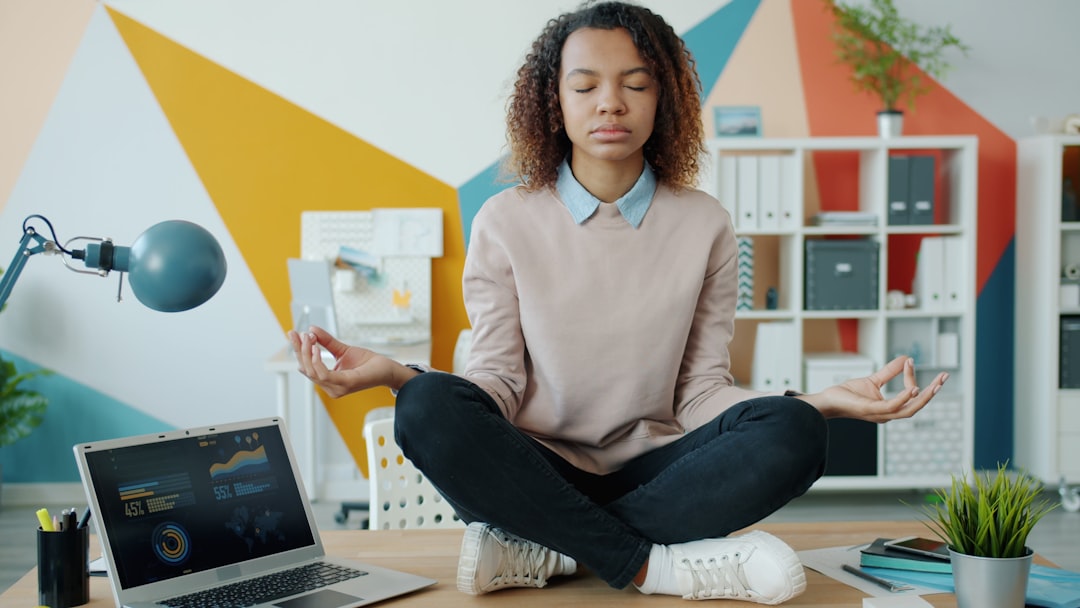
Sit up straight, plant both feet on the floor, and do 60 to 90 seconds of slow controlled breathing — inhale through the nose, exhale slower than the inhale — while bringing your attention to physical sensations instead of your thoughts. This activates your parasympathetic nervous system (the body’s built-in calming response) and interrupts the stress spiral fast enough to use between meetings, no eyes-closed, no-mat, no leaving-your-chair required.
3 Desk Meditation Techniques That Actually Work
**The physiological sigh (fastest option, ~60 seconds).** Take one long inhale through your nose, then — without exhaling — sneak in a second, shorter inhale on top of it to fully expand your lungs. Then let out a slow, long exhale through your mouth. Repeat this double-inhale-long-exhale pattern one to three times. This is the breathing pattern your body naturally uses to calm itself, and researchers at Stanford found it reduces acute stress and improves mood faster than simply breathing slowly or meditating in the traditional sense. It works with your eyes open, so it’s the most discreet option if you’re at a shared desk.
**Box breathing (2-5 minutes).** Inhale through your nose for a count of four, hold for four, exhale for four, hold for four, then repeat. Some people prefer a 4-7-8 variation instead — inhale for four, hold for seven, exhale for eight — which has a longer exhale and tends to produce a stronger calming effect per breath. Both are easy to do silently at your desk; you can even trace a small square with your eyes or a finger on the desk to keep count if your mind keeps wandering.
**A short body scan (3-5 minutes).** Close your eyes if you’re comfortable doing so, or soften your gaze downward if not. Starting at your feet, mentally scan upward through your legs, torso, shoulders, jaw, and face, noticing where you’re holding tension (clenched jaw and raised shoulders are common desk-stress spots) and consciously releasing it as you go. This works well when the overwhelm feels more physical — tight chest, tension headache — than mental.
How to Fit It Into a Busy Workday
You don’t need a dedicated meditation break to make this work — attach it to something you already do. Do a physiological sigh or two before opening your inbox in the morning, between back-to-back meetings, or right before a call you’re dreading. Many people also use the walk to get coffee or water as a moving version of this: a few slow breaths paired with noticing your feet on the ground.
If you share an office or sit in an open floor plan, keep your eyes open and your posture normal — nobody needs to know you’re doing anything other than pausing to think. Headphones playing a quiet 1-3 minute guided audio (many free options exist in apps like Insight Timer, Calm, or Headspace) can help you stay consistent without needing to remember the steps yourself.
For a slightly longer reset when you have 5 minutes and a closed door or empty conference room, combine the techniques: start with one physiological sigh to bring your heart rate down quickly, move into a minute or two of box breathing to steady it, then finish with a short body scan to release any leftover physical tension before you head back to your task list.
Tips and Common Mistakes
Don’t wait until you’re at peak overwhelm to try this for the first time — practice the breathing pattern once or twice when you’re already calm so it feels familiar under stress. Trying to force a completely blank mind is another common mistake; the goal isn’t to stop thinking, it’s to give your attention somewhere to land (the breath, the chair under you, the sounds in the room) instead of the spiral of thoughts causing the stress.
Keep the exhale longer than or equal to the inhale — a longer exhale is what signals your nervous system to downshift out of stress mode. Also skip the temptation to check your phone or read an email ‘just really quick’ in the middle of your reset; even a 60-second technique won’t do much if you interrupt it halfway through. If sitting still makes you more anxious, standing up and doing the same breathing pattern while walking to get water works just as well.
Explore more: Explore more meditation guides.
Quick Desk Meditation for Overwhelm FAQs
How long should a desk meditation be?
Anywhere from 60 seconds to 5 minutes works. A physiological sigh (one to three deep double-inhale breaths) takes under a minute and is enough for an acute stress spike; box breathing or a body scan for 2-5 minutes suits a deeper reset between tasks.
Do I need to close my eyes to meditate at my desk?
No. Closing your eyes can deepen the effect, but every technique in this guide works with your eyes open, which makes it usable in a shared office or during a video call buffer.
What’s the fastest way to calm down at work when I feel panicked?
Try the physiological sigh: two quick inhales through the nose back-to-back, followed by one long, slow exhale through the mouth. Repeat once or twice. It’s the quickest nervous-system reset of the techniques covered here.
Can breathing exercises really reduce stress, or is it just placebo?
Controlled breathing changes real physiological measures like heart rate variability and can lower activation of the body’s stress response — it’s a documented physiological mechanism, not just a mental trick, though how strongly you feel the effect varies from person to person.
Build Better Habits With ZenDuel
Track your habits and mood, stay accountable, and build a calmer routine — get the ZenDuel app. Get ZenDuel.
Photo by Vitaly Gariev on Unsplash.
