Most of us spend the bulk of our waking hours sitting at a desk — and most of that time, our minds are anywhere but present. Deadlines pile up, notifications pull attention in a dozen directions at once, and by mid-afternoon the mental fog is real. The good news is that you don’t need a meditation retreat, a special cushion, or even a quiet room to reset. Five minutes of intentional practice, right from your chair, is enough to shift your nervous system out of stress mode and back into focus.
Table of Contents
Below are five mindfulness exercises designed for desk workers. Each one takes five minutes or less, requires no equipment, and is discreet enough to do in a busy open-plan office without anyone noticing. Pick one to try today, and build from there.
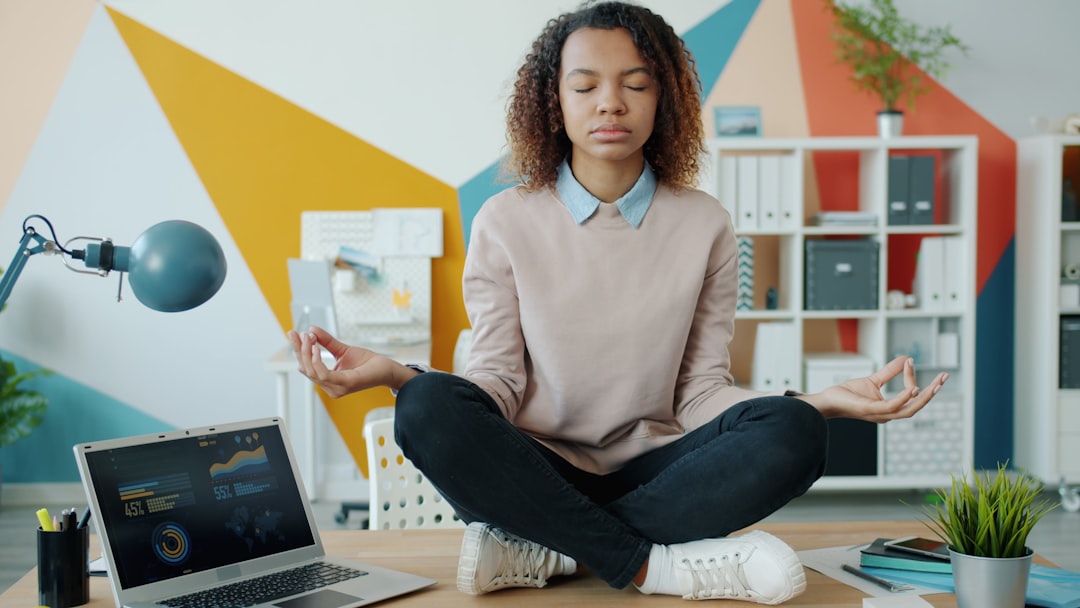
Quick Answer
The most accessible desk mindfulness exercises are box breathing (inhale 4 counts, hold 4, exhale 4, hold 4), a seated body scan, sensory grounding with the 3-3-3 method, a gratitude pause, and the STOP technique. Any one of these takes five minutes or less and can be done without leaving your chair.
5 Desk Mindfulness Exercises to Try Right Now
1. Box Breathing (4-4-4-4). Sit upright with your feet flat on the floor. Breathe in through your nose for a slow count of four. Hold for four counts. Exhale through your mouth for four counts. Hold again for four counts. That’s one cycle — repeat four to six times. Box breathing, sometimes called square breathing, activates the parasympathetic nervous system, your body’s built-in calm response. It’s a technique used by first responders and athletes precisely because it works quickly under pressure. Aim for around four minutes for the full effect, but even two cycles can take the edge off a stressful moment.
2. Seated Body Scan. Close your eyes or soften your gaze toward your desk. Take two or three slow breaths, then start at the top of your head and mentally scan downward — forehead, jaw, neck, shoulders, arms, hands, chest, belly, legs, feet. At each area, simply notice what’s there: tension, warmth, heaviness, or nothing at all. You’re not trying to fix anything, just observing. When you reach a spot of tightness, breathe into it and let the exhale release it. A full scan takes around five minutes and is one of the most effective ways to interrupt a stress spiral mid-workday.
3. Sensory Grounding (the 3-3-3 Method). When your mind is racing and deeper meditation feels impossible, sensory grounding is your fastest shortcut back to the present moment. Without leaving your seat, name three things you can see, three sounds you can hear, and three things you can touch within arm’s reach. Describe them internally — the color of your coffee mug, the hum of the air conditioning, the coolness of your desk surface. This exercise anchors your attention to the physical here-and-now, interrupting the loop of anxious or distracted thinking in under two minutes.
4. Gratitude Pause. Stop what you’re doing, close your eyes, and bring three specific things to mind that you’re genuinely grateful for today — not in the abstract, but concrete and recent. Sit with each one for about thirty seconds, noticing how it actually feels to appreciate it. A gratitude pause shifts your brain’s attentional focus away from problems and toward resources, making it especially useful before a difficult meeting or after a frustrating interaction.
5. The STOP Technique. This one is designed for moments when you catch yourself running on autopilot. The acronym stands for: Stop what you’re doing. Take one deliberate breath. Observe your current thoughts, feelings, and body sensations without judgment. Proceed with awareness. The whole thing takes under sixty seconds. What makes STOP powerful is that it creates a micro-pause between stimulus and response — exactly the space where you get to choose how to react rather than just reacting.
How to Build a Daily Desk Mindfulness Habit
The exercises above work best when they’re part of a regular rhythm, not just emergency tools. A practical approach is to anchor one exercise to something you already do: the moment you sit down with your morning coffee, the transition between meetings, or the minute before you open your email. Behavioral science calls this habit stacking, and it’s one of the most reliable ways to make new behaviors stick without relying on willpower.
Start with just one technique and practice it daily for a week before adding more. Consistency at a small scale matters far more than occasional longer sessions. Over time, even one mindful pause per day trains your nervous system to return to calm more quickly, so the practice starts taking less effort, not more.
If you share a workspace, note that every exercise here is effectively invisible. Seated box breathing, a closed-eyes body scan, or a quiet gratitude pause can all pass as someone taking a moment to think. You don’t need to announce it, retreat to a private room, or explain yourself to anyone.

Common Mistakes to Avoid
Waiting until you’re overwhelmed. Mindfulness exercises work best as maintenance, not just crisis management. The goal is to practice when you’re mildly stressed or even neutral — that’s when you build the neural pathways that make the techniques genuinely useful when things get hard. If you only try to meditate when you’re already in a spiral, the practice will feel harder and less effective than it should.
Judging the quality of your session. A mind that wanders constantly during a body scan is not a failed meditation — it’s a normal one. The practice is in noticing the wandering and gently returning your attention. Every redirect is a repetition, like a mental bicep curl. Beginners especially tend to give up because they expect a blank, quiet mind, but that’s not the goal and not how minds work.
Skipping short sessions because they feel too brief. Two minutes of genuine attention beats twenty minutes of going through the motions. Don’t let the perfect be the enemy of the practiced — a single box breathing cycle between back-to-back meetings has real value and is always available to you.
Explore more: Explore more mindfulness guides.
Desk mindfulness exercises FAQs
Do I need any special equipment or apps to do mindfulness at my desk?
No equipment is required for any of the exercises described here. Apps like Headspace, Calm, or the Mindfulness App can provide guided sessions if you prefer structure, but box breathing, body scans, and sensory grounding are all fully self-directed and can be done in total silence with no downloads needed.
How often should I practice desk mindfulness during the workday?
Even one intentional pause per day builds a foundation over time. Many practitioners find two to three short sessions — morning, after lunch, and late afternoon — effective for maintaining focus and managing stress throughout the day. Frequency matters more than duration, especially when you’re starting out.
Can I do these exercises if I work in an open office or on video calls?
Yes. All five exercises are designed to be discreet. Box breathing and the STOP technique are completely invisible. For body scans or gratitude pauses, a brief moment with eyes closed looks no different from thinking. For video calls, try the 3-3-3 grounding method with eyes open between meetings — it works just as well.
Build Better Habits With ZenDuel
Track your habits and mood, stay accountable, and build a calmer routine — get the ZenDuel app. Get ZenDuel.
Photo by Vitaly Gariev on Unsplash.
