High school is the first time most teens are juggling their own schedule: classes, homework, sports or clubs, a part-time job, and a phone that never stops buzzing. A habit tracker gives them one place to see what they’re actually doing each day instead of relying on memory or good intentions.
Table of Contents
Below is a free printable habit tracker designed specifically for teens, plus a simple system for using it so it actually sticks for more than a week. Grab the download near the top of this page and use the layout guide below to fill it in.

Download the Free Weekly Habit Tracker for High School Students
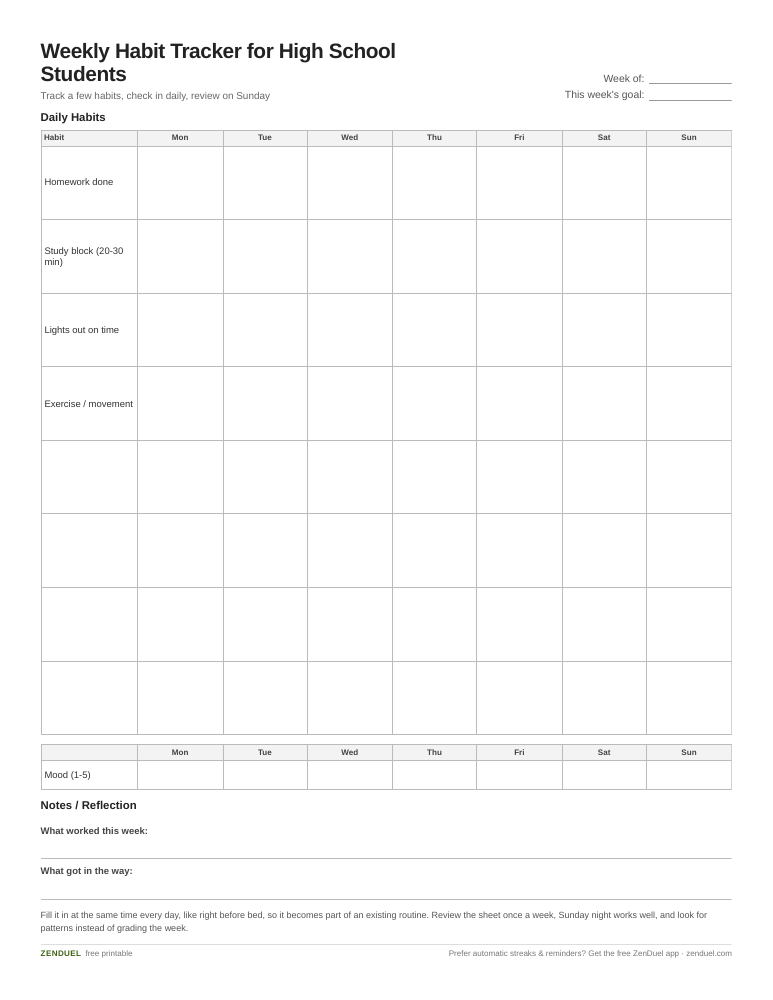
Our own printable — free, no sign-up, no email required. An 8-habit weekly grid with a mood row and a short reflection strip for a Sunday review. US Letter (prints fine on A4).
Quick Answer
A printable habit tracker for high schoolers works best as a one-page weekly grid with 5-8 habit rows (like homework, study time, sleep, screen time, and exercise) and checkbox columns for each day. Pick a handful of habits, check them off daily, and review the page once a week to see patterns.
What to Put on the Tracker
The printable attached to this post uses a layout built for a teenager’s actual week: a header row for the week’s dates and a short ‘this week’s goal’ line, then a grid with the days Monday through Sunday across the top and habit rows down the side. Each cell is a simple box to check or shade in, so filling it out takes seconds, not minutes.
Good starter habits for a high schooler’s tracker include: completed homework before a set time, a block of focused study time (even 20-30 minutes), lights out by a consistent time, no phone in the first or last 30 minutes of the day, some form of movement or exercise, reading for a set number of minutes, and drinking water instead of just soda or energy drinks. Keep the list to 5-8 habits — more than that and the sheet feels like a chore instead of a quick check-in.
At the bottom of the weekly grid, the printable also includes a small notes or reflection strip where a student can jot one line about what worked or what got in the way, plus a simple mood row (a few emoji-style boxes or a 1-5 scale) so they can connect how they felt to what they actually did that day.
For students who want a bigger-picture view, a monthly version works the same way but swaps the 7 day-columns for 30 or 31 columns across a single habit-per-row layout, which is useful for tracking one or two habits (like sleep or study time) across an entire month to spot longer trends.
How to Actually Use It
Print one sheet per week and keep it somewhere visible — taped inside a planner, on a desk, or stuck to the fridge. A tracker that lives in a backpack pocket gets forgotten fast.
Fill it in at the same time each day, like right before bed, so it becomes part of an existing routine instead of one more thing to remember. Checking off a box takes five seconds.
Start with habits that are already close to happening rather than a total overhaul. For example, if a student already does some homework most nights, the habit to track is ‘homework done before 9pm,’ not ‘perfect grades.’ Small, specific, and already-in-progress habits are far easier to keep checking off.
Sleep is worth tracking on its own: the CDC and American Academy of Sleep Medicine recommend teens aged 13-18 get about 8 to 10 hours of sleep a night, and a dedicated sleep row on the tracker makes it easy to see whether a rough week at school lines up with a rough week of sleep.
Review the sheet once a week — Sunday night works well — and look for patterns instead of grading performance. If study time only happened on days without practice, that’s useful information for planning the next week, not a reason to feel behind.

Tips / Common Mistakes
Tracking too many habits at once is the most common reason trackers get abandoned. Start with 3-5 habits for the first couple of weeks, then add more once checking the sheet feels automatic.
Don’t leave blank boxes unexplained. A quick note like ‘game night’ or ‘sick’ next to a missed day turns the tracker into useful data instead of a guilt trip.
Avoid habits that are too vague to check off, like ‘be more productive.’ Rewrite anything vague into something a student can look at and immediately know yes or no — ‘studied for 20 minutes’ instead of ‘studied enough.’
If paper isn’t practical for a particular student, the same grid works taped inside a school planner or on a wall calendar — the layout matters more than the exact paper size.
Explore more: more habit-building guides and trackers.
Printable Habit Tracker for High School Students FAQs
What habits should high schoolers track first?
Start with homework completion, a set study block, sleep, and screen time — these four tend to have the biggest effect on how the rest of the week goes, and they’re easy to check off as done or not done.
How many hours of sleep should a high schooler get?
The CDC and American Academy of Sleep Medicine recommend teens ages 13-18 get about 8 to 10 hours of sleep per night, which is why sleep is worth its own row on the tracker.
Should the tracker be weekly or monthly?
Weekly works best for most students because it matches the school schedule and makes reviewing easy. A monthly version is useful for watching one or two habits, like sleep, over a longer stretch.
What if a student misses several days in a row?
Just pick the tracker back up on the next day rather than starting a brand-new sheet or waiting for Monday. A short note on the missed days (‘exams,’ ‘travel’) keeps the pattern useful without turning it into a scorecard.
Skip the Spreadsheet — Track It in ZenDuel
Habit streaks, mood tracking, and accountability duels in one free app — no template maintenance required. Get ZenDuel.
Want a calmer inbox? Subscribe to the free newsletter.
Photo by Justin Morgan on Unsplash.