Most habit trackers are built for people with predictable energy: check a box every day, keep the streak alive, feel bad when you miss one. That design doesn’t work if you live with a chronic illness, chronic pain, or a fluctuating condition where some days you have ten spoons and some days you have two. A spoonie-friendly tracker has to measure effort and energy, not just yes-or-no completion.
Table of Contents
This guide explains what makes a habit tracker actually work for chronic illness, and walks through the layout of the free printable tracker included with this post: a flexible, rest-day-friendly weekly sheet you can print and use right away, no app, no account, no streak-shaming.
Download the Free Spoonie Habit Tracker
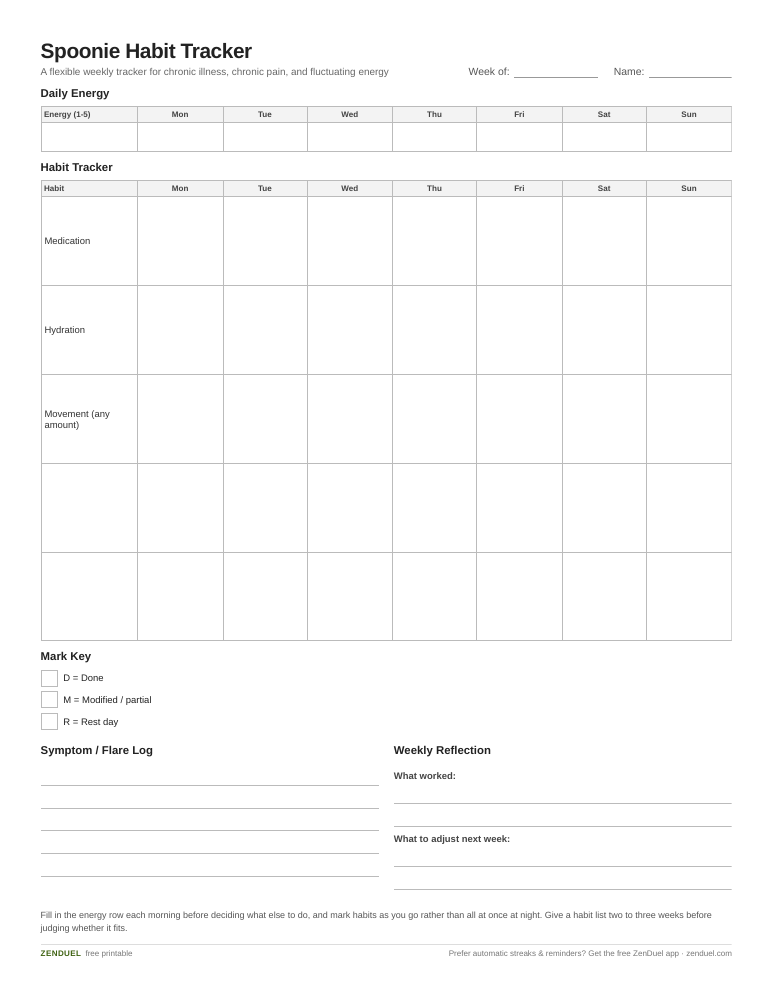
Our own printable — free, no sign-up, no email required. A daily energy row, a 5-habit by 7-day grid with done/modified/rest marks, plus a symptom log and weekly reflection boxes. US Letter (prints fine on A4).
Quick Answer
A chronic-illness-friendly habit tracker swaps strict daily streaks for a flexible weekly view: track a small number of realistic habits, log your energy or symptom level alongside each one, and treat rest days as a logged choice instead of a missed box. The free printable attached to this post is laid out that way — you can download and print it now.
What Makes a Habit Tracker ‘Spoonie-Friendly’
The term spoonie comes from spoon theory, a metaphor coined by writer Christine Miserandino in 2003 to explain life with lupus: each day you wake up with a limited number of “spoons” representing your available energy, and every task — showering, cooking, answering an email — costs at least one. Run out of spoons and you’re done for the day, regardless of what’s left on your to-do list. The metaphor has since been adopted widely across chronic illness, chronic pain, and chronic fatigue communities.
A tracker designed around that reality has a few specific features. It separates the habit from the outcome, so “moved my body today” can mean a ten-minute walk or ten minutes of gentle stretching in bed — both count. It tracks energy or pain level as its own column, not just whether a habit happened, so you can see patterns (like a flare showing up two days after a high-exertion day) instead of just a string of empty boxes. And it never frames a skipped day as failure — a blank or shaded cell just means “rest day,” which is information, not a broken streak.
How to Use the Free Printable Tracker
The attached PDF is a one-page weekly layout, sized to print on standard letter paper. Across the top, there’s a space for the week’s date range and a short daily energy row — one box per day where you jot a quick 1-5 number or a few spoon icons for how much capacity you had, before you look at anything else. That number becomes useful context for everything below it.
Below that sits the main grid: five habit rows down the left side, left blank so you can fill in whatever actually matters to you this week (medication, hydration, stretching, a short walk, pacing a rest break), with seven columns across for the days of the week. Instead of a single checkbox, each cell has three simple marks you choose from — done, modified/partial, or rest day — so a lower-effort version of a habit still counts as progress instead of a miss.
Underneath the grid is a slightly larger notes section split into two halves: a symptom/flare log on the left for jotting anything worth remembering (a new trigger, a medication change, a good or bad sleep night), and a short weekly reflection box on the right with two prompts — “what worked” and “what to adjust next week.” That reflection box is what turns the sheet from a log into an actual planning tool over time.
To use it: print one sheet per week, fill in the energy row each morning before you decide what else to do that day, mark habits as you go (not all at once at night, which is easy to forget), and spend two minutes on the reflection box at the end of the week. Keep a small stack of printed sheets in a binder or clipped together so you can flip back and spot patterns month to month.
Tips / Common Mistakes
Tracking too many habits at once is the most common mistake — pick two to five that genuinely matter, not a wishlist of everything you’d do on a perfect day. Treating a rest-day mark the same as failure defeats the entire point of the layout; the mark exists so you have real data about your energy, not a guilt trigger. Filling in the whole week from memory on Sunday night loses most of the value — the energy row and habit marks are only useful if they’re logged close to when they happen. Finally, don’t redesign the habits list every week; give a set of habits at least two to three weeks before deciding whether they fit, since illness patterns are noisy day to day and a single bad week isn’t a trend.
Explore more: more habit-tracking tools and guides.
Spoonie habit tracker for chronic illness FAQs
What’s the difference between this and a regular habit tracker?
A regular tracker usually rewards an unbroken daily streak with a single checkbox. This one tracks energy level alongside each habit and gives credit for a modified or lower-effort version of a habit, plus a dedicated rest-day mark, so a flare-up week still produces useful data instead of just a row of misses.
Do I need the app version or a special program to use this?
No. The tracker is a printable PDF you download for free and print at home, with no sign-up and no app required. You fill it in with a pen.
How many habits should I track at once with a chronic illness?
Start with two to five. Tracking too many habits at once is harder to sustain and makes it tougher to spot which habits are actually connected to how you feel, which is the main benefit of tracking in the first place.
Skip the Spreadsheet — Track It in ZenDuel
Habit streaks, mood tracking, and accountability duels in one free app — no template maintenance required. Get ZenDuel.
Want a calmer inbox? Subscribe to the free newsletter.
Photo: Auckland Museum Collections from Auckland, Aotearoa New Zealand / CC BY 2.0, via Wikimedia Commons.