Quitting smoking is less about willpower on day one and more about noticing patterns over the following weeks — when cravings hit, what sets them off, and what actually gets you through them. A printable habit tracker turns that noticing into a simple daily habit instead of something you try to remember in your head.
Table of Contents
Below you’ll find exactly how to use a quit-smoking tracker, what to log each day, and a layout you can print and start filling in today. The attached printable follows this same structure, so you can grab it and go straight to day one.
Download the Free Quit-Smoking Habit Tracker
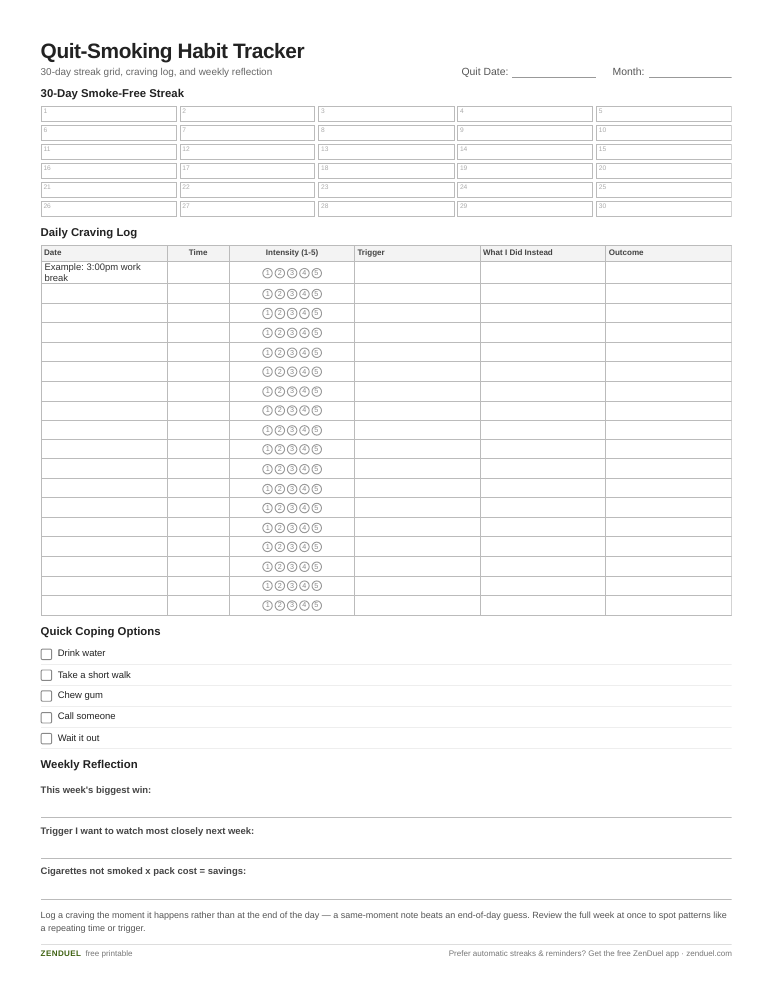
Our own printable — free, no sign-up, no email required. A 30-day smoke-free streak grid, a daily craving log with trigger and outcome columns, a quick coping-options checklist, and a weekly reflection box. US Letter (prints fine on A4).
Quick Answer
A quit-smoking habit tracker works best as a one-page printable with a monthly grid for marking smoke-free days plus a daily log for cravings, triggers, and coping strategies. Fill it in for about a week before your quit date to learn your patterns, then keep logging daily after you quit — tracking cravings as they happen is one of the simplest ways to make them easier to manage and spot which triggers need a plan.
How to Use the Tracker, Step by Step
Start a few days before your actual quit date, if you can. For each cigarette (or vape session) you have, jot down the time, where you were, who you were with, and how strong the urge felt on a simple 0-3 scale (0 = none, 3 = intense). You’re not trying to quit yet at this stage — you’re just collecting data on your own patterns.
On and after your quit date, flip the tracker’s purpose: instead of logging each cigarette, log each craving. Note the time it hit, what triggered it, how intense it was, and what you did instead — drank water, went for a walk, chewed gum, called someone, or just waited it out. At the end of each day, mark the daily grid box as smoke-free or not, and jot one line about what worked or what you’d do differently.
Review the tracker weekly rather than only daily. Patterns that aren’t obvious after one day — like cravings clustering around a 3pm work break or right after meals — usually become clear after five to seven days of entries, and that’s exactly when you can start building a specific plan for those moments instead of reacting in the moment.
What’s on the Printable (and How to Lay It Out Yourself)
The attached printable is built as a single page split into three parts. At the top is a 30-day grid — six rows of five boxes — where you mark each day smoke-free or not with a quick checkmark or X, so your streak is visible at a glance.
Below the grid is a daily log table with columns for Date, Time, Craving Intensity (1-5), Trigger, What I Did Instead, and Outcome. Each row covers one craving entry, so a busy day might fill several rows while a calm day might only need one or two.
At the bottom is a short weekly reflection box with lines for your biggest win that week, the trigger you want to watch most closely next week, and a simple savings line — cigarettes not smoked multiplied by what a pack costs you, so progress stays visible in a way that isn’t just a streak count. If you’d rather build your own version, those three sections (streak grid, craving log, weekly reflection) are the core structure worth keeping no matter how you format it.

Tips and Common Mistakes
Keep the tracker somewhere you’ll actually see it — on the fridge, by your coffee maker, or in your bag — rather than in a drawer you only open at night. A tracker you forget to fill in daily won’t show you real patterns.
Don’t treat a slip as reason to throw out the tracker. If you smoke after a smoke-free stretch, log it the same way you’d log anything else — time, trigger, intensity — and keep going. The data from a slip is often the most useful entry on the whole page because it points straight at a trigger you haven’t planned for yet.
Watch the first week especially closely, since it’s typically the period with the strongest and most frequent cravings and the highest chance of going back to smoking — a few quick coping options written at the top of your tracker (water, a short walk, a phone call, gum) save you from having to think of one from scratch mid-craving. Most people find physical symptoms ease noticeably within a couple of weeks, with the toughest stretch concentrated in the first several days.
Finally, don’t rely on memory instead of the sheet. Writing an entry takes ten seconds and the honesty of a same-moment log beats an end-of-day guess every time.
Explore more: more habit trackers and tools.
Quit-smoking habit tracker FAQs
How long should I use a quit-smoking tracker?
Most people get the most value from daily logging through the first month, since that’s typically when withdrawal symptoms and cravings are strongest. After that, many switch to just marking the daily streak grid and only filling in a detailed log entry when a craving catches them off guard.
Should I track before I quit or only after?
Both, if you can. Logging your smoking pattern for about a week before your quit date helps you see your real triggers, while logging cravings after you quit helps you manage them and catch slips early.
What if I miss a day on the tracker?
Just pick it back up the next day. A gap in the log doesn’t undo your progress — leave the box blank or mark it as unlogged and move on rather than abandoning the tracker over one missed day.
Skip the Spreadsheet — Track It in ZenDuel
Habit streaks, mood tracking, and accountability duels in one free app — no template maintenance required. Get ZenDuel.
Want a calmer inbox? Subscribe to the free newsletter.
Photo by Road Ahead on Unsplash.