Early recovery runs on small, repeatable wins — the next hour, the next meeting, the next honest check-in with yourself. A printable habit tracker gives those wins a visible home, instead of letting them disappear into a day that already feels hard enough to get through.
Table of Contents
Below is a free printable habit tracker designed specifically for sobriety and recovery, plus a plain-English guide to using it: what to track, how to build it into a daily routine, and the mistakes that make most trackers get abandoned by week two.

Download the Free Daily Recovery Habit Tracker
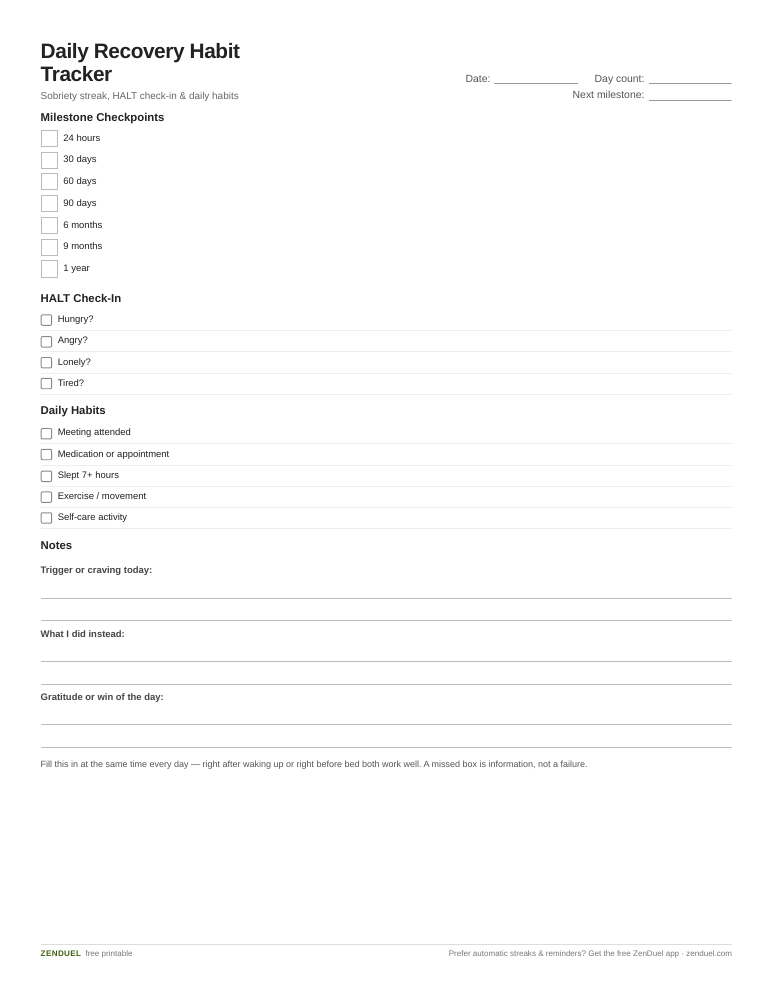
Our own printable — free, no sign-up, no email required. A one-page daily log with streak fields, a HALT check-in, five habit checkboxes, and trigger/gratitude notes. US Letter (prints fine on A4).
Quick Answer
Grab the free printable habit tracker attached to this post — it’s a one-page daily log with a sobriety streak counter, a HALT check-in (Hungry, Angry, Lonely, Tired), space for triggers and coping actions, and a simple habit grid for the routines that support staying sober (sleep, meetings, exercise, meds). Print one per week or per month and fill it in at the same time each day.
What to Include on a Recovery Habit Tracker
The printable is built around a few sections that map to how recovery programs and counselors actually ask people to self-monitor. At the top is a streak counter — the day number since your last use, plus the next milestone you’re working toward. It helps to know the standard checkpoints people in programs like AA mark with chips or coins: 24 hours, 30 days, 60 days, 90 days, 6 months, 9 months, and 1 year, then annually after that. Writing the countdown to the next one turns a long stretch of time into something achievable this week.
Below that is a daily HALT check-in — four small boxes asking ‘Am I Hungry, Angry, Lonely, or Tired?’ This is a widely used recovery acronym because those four states are common triggers for cravings, and naming them takes away some of their power. Next comes a habit grid: a row of checkboxes for the supporting habits that keep sobriety stable — meeting attendance, medication or appointment, sleep (7+ hours), movement/exercise, and one self-care item (journaling, calling a sponsor, prayer or meditation). Check them off daily so patterns — like skipped sleep showing up before a rough day — become visible instead of invisible.
The bottom third is open space for two short notes: ‘Trigger or craving today’ and ‘What I did instead.’ This is the single most useful line on the page, because it builds a written record of what actually works for you, not generic advice. A final small box for gratitude or a win of the day closes out the entry on something positive rather than just a list of problems.
How to Actually Use It Day to Day
Fill it in at a fixed time, not whenever you remember — most people do it either first thing in the morning (planning the day) or right before bed (reviewing it). Keep the printed sheet somewhere you’ll see it: on a fridge, in a day planner, or clipped inside a recovery journal, not buried in a drawer. If a day gets missed, fill in what you can remember rather than skipping the whole week — a tracker with gaps is still more useful than no tracker at all.
Use the weekly or monthly version depending on how much detail helps you. Day one to day thirty, many people do better with one tracker per day so there’s enough room to write. Once a routine is established, a monthly grid with just the habit checkboxes and streak count is often enough, with a notes page kept separately for trigger and craving entries.
If you’re supporting someone else in recovery, the tracker also works as a low-pressure way to check in — asking to see the habit grid is less confrontational than asking ‘are you doing okay?’ and gives a concrete, factual starting point for a conversation.

Tips & Common Mistakes
Don’t make the tracker a scorecard. The goal is pattern recognition, not a perfect streak of checkmarks — a missed habit box is information, not a failure to report to anyone. Don’t skip the trigger/notes section even on good days; the easy days are exactly when it’s worth writing down what made them easy. Avoid making the page too complex — if it takes more than two or three minutes to fill in, it will get skipped during a hard stretch, which is exactly when you need it most. Keep a few blank copies on hand (printed or saved) so starting a new page after a slip is a non-event, not a hurdle. And keep the sheet private or shared only with people you trust — the honesty of the entries matters more than anyone else seeing them.
Explore more: more free habit trackers and printables.
Free Printable Habit Tracker for Recovery and Sobriety FAQs
Is this printable habit tracker free to download?
Yes — it’s attached directly to this post as a free, no-sign-up PDF you can print as many times as you need.
What is the HALT check-in and why is it on the tracker?
HALT stands for Hungry, Angry, Lonely, Tired — four common states that can trigger cravings in recovery. Checking in on all four daily helps catch a risky mood before it turns into a crisis.
How often should I fill out the tracker?
Daily, at the same time each day, works best. Early in recovery a full one-page-per-day version helps; once habits are established, a simpler monthly checkbox grid is usually enough.
What if I miss a day or have a setback?
Fill in what you remember and keep going — a tracker with gaps is still useful. Keep extra blank pages on hand so starting fresh after a slip takes no extra effort or stigma.
Skip the Spreadsheet — Track It in ZenDuel
Habit streaks, mood tracking, and accountability duels in one free app — no template maintenance required. Get ZenDuel.
Want a calmer inbox? Subscribe to the free newsletter.
Photo by Prophsee Journals on Unsplash.